
When Doing Everything Right Stops Working
What I had to unlearn about applying, waiting, and how things actually move

1. Just Get It Right

“If you build it, they will come”
I’ve spent hundreds of hours refining my resume.
I mean everything from rewriting bullets and then painfully quantifying each one’s impact and placement. Trying to make sure the work I’ve been doing is reflected and understandable to all audiences.
For a long time, I thought that was the work.
That if I could just get my resume right and apply thoughtfully enough, eventually the right opportunity would come.
There was this unspoken belief underneath all of it. That if I presented myself clearly enough, the right people would see it. I blindly believed the system would work the way it’s supposed to.
You apply.
They review.
There is alignment.
You move forward.
Full stop!
At least, that’s the story I told myself.
And for a while, I believed it.
2. No Response Is Still a Response
“Silence speaks volumes”
But after enough silence, you start to notice something else.
It’s not just that you’re not getting the role. But you’re not even making it into the conversation.
No interview.
No feedback.
No indication that anyone actually engaged with what you sent. It’s radio silence in your inbox.
And that’s a very different kind of signal.
Rejection is easier to process over absence. At least rejection confirms visibility. It says someone evaluated your credentials and decided no.
Prolonged silence changes how you interpret your own visibility and value within systems. It leaves room for interpretation. And over time, as doubt settles in, it starts to reshape the way you see yourself inside the system.
The hardest part wasn’t the silence itself. It was accepting the strategy to optimize was no longer effective. No longer producing results.
3. One More Revision
“Fix it in post”
There’s a certain comfort in believing you’re just one revision away.
Because that’s something you can control.
And it feels productive.
Even when it isn’t moving anything forward.
But recognizing that the path itself needs to change…. It means facing brutal honesty and accepting the hours or revisions were just busy work to distract from the unbearable silence.
4. Knuck If You Buck

“We’re knucking and bucking and ready to fight!”
I even tried to solve it with AI.
Refining language.
Reworking and reframing positioning.
Asking it to say the same thing ten different ways, hoping one of them would finally land.
On the surface, it appeared to help. The resume got tighter, clearer…
more aligned with the level I’ve been operating at. And briefly, that felt intoxicating. It felt like progress.
But that’s also part of what made it so frustrating. Every rewrite sounded stronger. And yet AI always seemed ready with another way to position it.
So even when the results weren’t changing, there was always this subtle suggestion that maybe the breakthrough was still one more revision away.
Meanwhile, the silence in my inbox got louder. There was still no real signal as to what was or wasn’t landing. And that was the part that started to wear on me. Because each rewrite made the story stronger, but it didn’t make me any more visible.
Riddled with frustration, I felt hopeless.
There was no feedback loop. No indication of what was resonating. No clarity around whether the issue was positioning, access, timing, algorithms, bias… or something else entirely.
Just more refinement… and the same end result.
And at some point, the optimizations stopped feeling like progress…
and started feeling like I was solving the wrong problem.
5. This Isn’t That Stage Anymore

“What got you here won’t get you there”
Eventually, I had to confront something uncomfortable:
Maybe the problem wasn’t that I wasn’t qualified.
Maybe I was still trying to move through a system designed for an earlier stage of my career. Because early on, effort and execution do create momentum.
But the level I’m operating at now doesn’t move that way.
And that was hard to admit. Hard to accept.
Not because I didn’t understand it.
But because I didn’t want it to be true.
I didn’t want access to depend so heavily on proximity.
On relationships.
On who knows your name before they know your work.
I didn’t want visibility to require constant self-advocacy and strategic networking just to enter rooms I was already qualified to be in. Part of me still believed strong work should eventually speak for itself.
That if I kept refining, improving, and delivering, the right people would recognize it organically.
But somewhere along the way, I had to confront the possibility that being valuable and being visible are not always the same thing. And that the people who move forward fastest are not always the most qualified. Sometimes they’re simply the most visible.
And once I saw that clearly, I couldn’t keep approaching my career the same way.
6. Outgrowing the Model
“This ain’t that”
At some point, I had to admit something I really didn’t want to admit. I’ve outgrown the “apply and wait” model. Even writing that feels uncomfortable.
Because part of me still wants to believe the process is mostly linear:
You gain experience.
You get better.
You apply.
Eventually someone recognizes it.
But that hasn’t been my reality. I spent so much time convincing myself each new version was the breakthrough. And maybe that works at certain stages.
But eventually I had to face the possibility that I was struggling because I kept trying to force a relationship-based stage of growth through a transactional process.
And continuing to rely on that process was keeping me in the same loop.
Ironically, loops tend to feel a lot like progress… until you realize you’re ending up in the same place.
I had spent so much time assuming the goal was to communicate my value more clearly. But what if clarity only matters after you’ve made it through the filters?
7. Wrong Problem, Right Effort
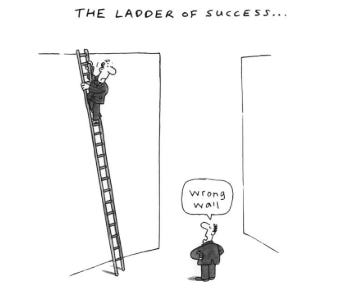
“Right message, wrong room”
That’s when it clicked.
I wasn’t lacking clarity.
I was applying clarity in the wrong place.
AI can help you say things better. But it doesn’t change how systems evaluate candidacy.
And if the system is optimizing for speed, pattern recognition, and risk… Then no amount of refinement changes the fact that you’re still being filtered out before you’re understood.
Which means the issue isn’t effort.
It’s where that effort is landing.
8. Move Differently

”Closed mouths don’t get fed”
Honestly, that shift didn’t feel empowering at first.
I felt frustrated. It felt unfair!
Because it meant I couldn’t just rely on doing the work and presenting it well. It meant I had to move differently. I had to be more intentional about which rooms I enter. More direct about who I build relationships with. And definitely more honest about the difference between being respected and being advocated for.
At certain levels, careers don’t move forward on performance alone. They are cultivated through sponsorship.
Visibility.
Trust.
Proximity.
Timing.
And most importantly, the right people willing to say your name in rooms you’re not in.
At some point, you have to stop internalizing the stagnation long enough to really assess the environment. If you pay close attention, you will see if the picks have already been made.
Organizations usually show you who they’re investing in, who they’re accelerating, and how they ultimately see you. And part of moving differently is recognizing that signal sooner.
Not spending years overperforming, hoping exceptional work will eventually change a perception that was probably formed long before you realized it.
That doesn’t mean stop doing great work. It just means great work and career movement are not always driven by the same thing.
9. You Can’t Unsee It
“Know better, do better”
And if I’m honest, that’s still something I’m learning to navigate in real time.
Because once you see how things actually move, you can’t go back to believing they move on merit alone.

“It’s not you, it’s the system”
You start noticing patterns everywhere.
Who gets advocated for.
Who gets developed.
Who gets visibility.
Who gets the benefit of proximity.
Who gets told to “be patient.”
And who gets filtered out long before their work is fully understood.
I think the hardest part is realizing how much of this goes unspoken.
Because from the outside, everything still appears to be merit-based. And once you notice those patterns, it’s hard to unsee them.
I’ve realized this goes way beyond job searching. It affects career acceleration at every stage.
Sometimes misalignment looks like staying too long somewhere that already made up its mind about you.
Sometimes it looks like overperforming because you think one more win will finally change how you’re viewed.
And sometimes it’s spending years refining yourself for systems that were never really built to slow down and fully see people individually in the first place.
I don’t think that makes me cynical. Just more aware of how much environment shapes momentum.
I don’t have the full answer yet.
But at least now I understand the difference between needing to grow… and endlessly reshaping yourself to fit environments that were never expanding with you in the first place.
This articulated something many high performers eventually realize, but rarely say out loud: being valuable and being visible are not always the same thing.
What resonated most for me was the tension between believing strong work should eventually “speak for itself” and realizing that, at certain levels, access and advancement move through relationships, trust, sponsorship, proximity, and perception.
I’ve seen this dynamic play out repeatedly inside organizations, especially at senior levels where opportunities are often decided long before they are formally posted. Not because talent doesn’t matter, but because human systems are still driven by familiarity, narrative, emotional trust, and who people feel safe accelerating under pressure.
That realization can feel deeply disorienting for people who were taught that excellence alone creates momentum.
Part of what I explored in The Access Code: Emotional Sovereignty™ is the importance of understanding both yourself and the environment you’re operating within. Sometimes the breakthrough is not another revision of yourself. Sometimes it’s recognizing the system, the room, the incentives, the visibility dynamics, and whether your growth is actually being expanded or quietly contained.
“Right message, wrong room” was an especially powerful line.
Thank you for writing this with so much honesty and nuance.